
At a phase transition in thermodynamic equilibrium, the static properties of a system change qualitatively, such as from a para- to a ferromagnetic phase. By contrast, at a so-called non-Hermitian phase transition (NHPT) far away from thermodynamic equilibrium, a qualitative change of the system’s dynamical behavior occurs, for instance from bi-exponential to oscillatory relaxation. NHPTs play an important role in the nonequilibrium dynamics of many-body systes and have been observed in engineered systems such as nanoscopic devices, atomic-gases, photonic systems and, especially, within the CRC OSCAR in Bose-Einstein condensates of photons (Project B1).
In a theory-experiment collaboration of the groups of Johann Kroha (Project B1) and of Manfred Fiebig (ETH Zürich), an NHPT has now been observed and identified in the exciton dynamics of a bulk condensed-matter system. At the NHPT, the relaxation times and the oscillation frequency, respectively, undergo a bifurcation, that is, they change with an infinite slope across the NHPT, giving rise to enhanced sensitivity to external parameter changes. As a bulk material effect, this might be utilized in future sensing and control applications.
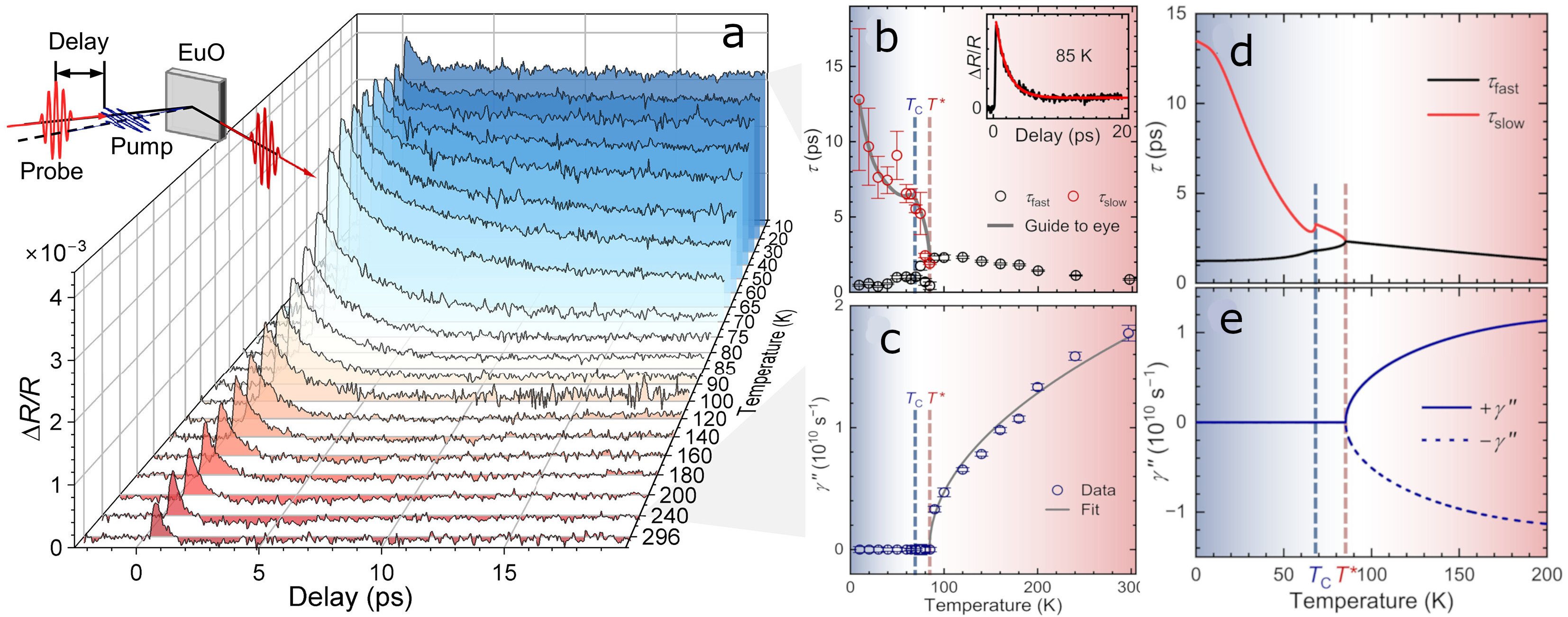
The figure shows a) the raw data from time-resolved pump-probe reflectivity measurements on europium monoxide, EuO, as well as the relaxation times and oscillation frequencies as extracted from the experiments [b) and c), respectively.] and as derived from theory [d) and e), respectively]. The bifurcation with infinite slope is visible at the NHPT critical temperature T*. The kink in the relaxation times at the Curie temperature TC signals the ferromagnetic ordering transition of the material, both in the experimental and the theoretical results.
Journal article:
Discovery of an intrinsic non-Hermitian phase transition in a bulk condensed-matter system,
J. Li, M. Turaev, M. Matsubara, K. Kliemt, C. Krellner, S. Pal, M. Fiebig, and J. Kroha, Science 393,1152 (2026).
DOI: 10.1126/science.ady4670
Open-access link:
https://www.science.org/doi/10.1126/science.ady4670