Josephson junctions are key elements of modern quantum technology, enabling high-precision measurements, realizing the voltage standard, and forming the basis of many quantum computers. To investigate the underlying microscopic processes—difficult to access directly in superconductors—researchers at RPTU (University of Kaiserslautern-Landau) implemented a dedicated quantum simulation of the Josephson effect. Two Bose–Einstein condensates were separated by an ultrathin, periodically modulated optical barrier created by a focused laser beam. This configuration reproduced characteristic Shapiro steps—voltage or energy plateaus at integer multiples of the modulation frequency—closely analogous to those observed in superconducting systems. The results, published in Science, illustrate the universality of Josephson phenomena and highlight the potential of quantum simulation for probing complex quantum effects.
A Josephson junction consists of two superconductors separated by a nanometer-thin insulating layer. Despite its apparent simplicity, this system exhibits a quantum mechanical tunneling effect that has become a cornerstone of precision metrology and quantum technology. Josephson junctions form the core of many quantum computers and are essential for realizing highly accurate measurements of voltage and magnetic fields.
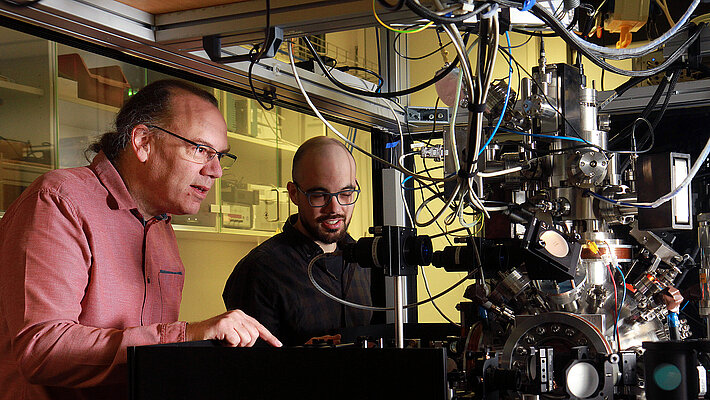
To access the microscopic quantum dynamics at the junction, researchers employ quantum simulation. This approach maps a complex quantum system onto another, more controllable platform, thereby enabling the study of effects that would otherwise remain experimentally inaccessible. In the recent RPTU study, the research group led by Herwig Ott applied this concept to the regime of Shapiro steps. Instead of superconductors, they used an ultracold atomic gas forming a Bose–Einstein condensate and separated two such condensates by a periodically moving optical barrier generated by a focused laser beam. This setup emulates a superconducting Josephson junction exposed to microwave irradiation, which induces an additional alternating current through the junction.
This configuration allowed the team to observe Shapiro steps in the atomic system—quantized plateaus that depend only on fundamental constants and the modulation frequency and that serve as the global basis for voltage calibration. “In our experiment, we observe a chemical potential difference between both condensates in close analogy to the voltage drop in superconductors. Moreover, we were able to visualize the resulting excitations for the first time. The observation of this effect in an entirely different physical system—an ensemble of ultracold atoms—demonstrates the universality of Shapiro steps,” explains Herwig Ott.
The research was conducted in collaboration with theoretical groups led by Ludwig Mathey at the University of Hamburg and Luigi Amico at the Technology Innovation Institute in Abu Dhabi. According to Ott, the study exemplifies the essence of quantum simulation: “A quantum mechanical effect from solid-state physics is transferred to an entirely different physical system—yet its fundamental nature remains unchanged. This work builds bridges between the quantum worlds of electrons and atoms.” Looking ahead, Ott and his team aim to connect multiple such atomic Josephson junctions to construct “atomic circuits,” in which atoms rather than electrons flow—an emerging field known as atomtronics. “Such circuits are particularly well suited for investigating coherent, wave-like effects,” notes Erik Bernhart, who conducted the experiments as part of his doctoral research. Furthermore, atomic motion in these systems can be directly observed, which is far more challenging in solid-state electronic circuits. In future work, the researchers plan to realize additional fundamental circuit elements using atoms and ultimately integrate them into more complex circuits.
The study:
Erik Bernhart, Marvin Röhrle, Vijay Pal Singh, Ludwig Mathey, Luigi Amico, and Herwig Ott
“Observation of Shapiro steps in an ultracold atomic Josephson junction”
www.science.org/doi/10.1126/science.ads9061
Scientific contact::
Prof. Dr. Herwig Ott
Departement of Physics at
RPTU University Kaiserslautern-Landau
T: +49 631 205 2817
E: